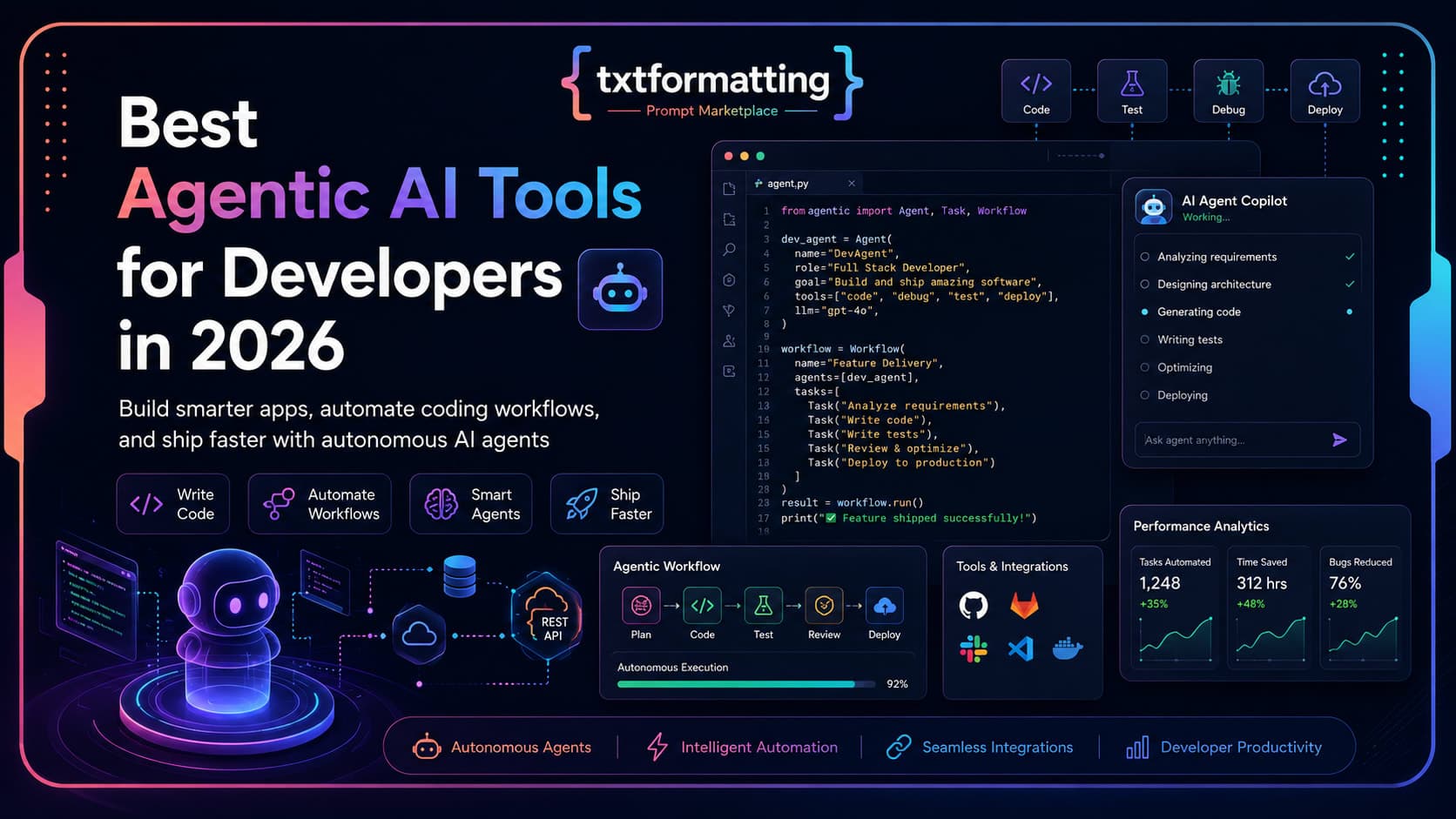
Discover the 12 best agentic AI tools developers are using in 2026 — from LangGraph and CrewAI to Claude Code and Devin. Build smarter, ship faster.
Developers who are still treating AI as an autocomplete engine are about to get lapped.
In 2026, the top engineering teams are running agentic AI systems — workflows where AI plans multi-step tasks, calls tools, self-corrects, and executes without constant human supervision. The shift from "assistant" to "agent" is the single biggest architectural leap in software development since the cloud.
This guide covers the 12 best agentic AI tools for developers in 2026 — what each one does, where it shines, and when to reach for it.
Why Agentic AI Is the Developer's New Superpower
Traditional LLM prompting has a ceiling. You ask, it answers, you copy-paste. Agentic AI breaks that ceiling by adding planning, memory, tool use, and self-correction to the loop.
The pain points agentic AI eliminates:
- Hours lost scaffolding boilerplate, writing tests, and reviewing PRs
- Multi-step workflows that break with single-turn prompting
- Manual API integrations that any decent agent can auto-generate
- Context-switching between 10+ tools when one agent can orchestrate them all
The numbers don't lie:
- GitHub reports developers using AI coding tools are 55% more productive on average
- McKinsey estimates AI coding assistants save senior developers 1–3 hours per day
- The agentic AI market is projected to hit $47 billion by 2028
- 78% of Fortune 500 companies are actively deploying AI agents in 2026 (Gartner)
If you're building products, internal tools, or client services, agentic AI isn't optional anymore — it's the competitive baseline.
The 12 Best Agentic AI Tools for Developers in 2026
1. Claude (Anthropic) — Best for Complex Reasoning + Long Context
Claude, built by Anthropic, remains the go-to model for tasks requiring deep reasoning, nuanced code review, and handling massive codebases in a single context window.
Key features:
- 200K token context window (fits entire repos)
- Native tool use via the Anthropic API
- Model Context Protocol (MCP) support — connects Claude to databases, APIs, and file systems
- Industry-leading performance on coding, math, and instruction-following
Best for: Code review, architecture planning, generating complex multi-file changes, and any task where reasoning quality matters more than raw speed.
Use case: A dev team uses Claude via the API with MCP connectors to automatically review PRs, suggest fixes, and update documentation — cutting code review time by 70%.
2. OpenAI Assistants API (GPT-4o) — Best for Production-Grade Agent Deployment
The OpenAI Assistants API gives you persistent threads, built-in tool calling (code interpreter, file search, function calling), and native stateful agents without managing your own memory layer.
Key features:
- Persistent conversation threads with managed memory
- Built-in Code Interpreter for running Python in a sandbox
- File search over uploaded documents
- Parallel function calling for multi-tool workflows
Best for: Building customer-facing AI assistants, data analysis agents, and production chatbots where you need managed infrastructure.
Use case: A SaaS startup builds a support agent that reads user documentation, runs code examples, and resolves 65% of tier-1 support tickets without human intervention.
3. LangGraph (LangChain) — Best for Building Custom Agent Graphs
LangGraph is the framework developers reach for when they need precise control over complex, multi-step agent workflows. It models agents as directed graphs — nodes are actions, edges define flow.
Key features:
- State machine approach to agent design (no black-box loops)
- First-class support for human-in-the-loop checkpoints
- Cycles, conditional branching, and parallel execution
- Built-in persistence for long-running workflows
Best for: Teams that need production-grade control over agent behavior — debugging and observability are first-class citizens.
Use case: A fintech team builds a loan underwriting agent using LangGraph — each step (document extraction, credit check, risk scoring) is a node with full audit trails.
4. CrewAI — Best for Multi-Agent Collaboration
CrewAI makes it easy to define a "crew" of specialized AI agents that collaborate to complete complex tasks. Think: researcher agent + writer agent + critic agent working in sequence or parallel.
Key features:
- Role-based agent definitions (easy to reason about)
- Sequential and hierarchical process execution
- Built-in task delegation and inter-agent communication
- 1-minute setup for simple multi-agent pipelines
Best for: Tasks that naturally split into distinct roles — research + synthesis, data extraction + analysis, writing + editing.
Use case: A content agency automates blog production: one agent researches, one writes, one checks SEO, one edits — producing publish-ready content 10x faster.
5. AutoGen (Microsoft) — Best for Research and Complex Conversations
AutoGen pioneered the "conversable agent" pattern — where multiple AI agents and human proxies collaborate in a group chat to solve problems iteratively.
Key features:
- Flexible agent conversation patterns (two-agent, group chat, nested)
- Human proxy agents for approval workflows
- Code execution in sandboxed environments
- Strong research and enterprise backing from Microsoft
Best for: Research tasks, complex problem decomposition, and workflows where you want agents to debate and verify each other's outputs.
Use case: A data science team runs AutoGen agents to explore datasets, generate analysis code, critique results, and produce executive summaries — autonomously.
6. Claude Code — Best CLI Coding Agent
Claude Code is Anthropic's CLI-native agentic coding tool. You run it in your terminal, point it at a codebase, and give it tasks — it reads files, edits code, runs tests, and commits changes.
Key features:
- Full codebase awareness via file reading and search
- Runs shell commands, tests, and builds
- Git-aware (can branch, commit, and create PRs)
- Model Context Protocol for connecting external tools
Best for: Developers who want a powerful coding agent in their terminal without a heavyweight IDE integration.
Use case: A solo founder uses Claude Code to migrate a legacy Express API to TypeScript — handling types, updating tests, and fixing build errors in a single session.
7. Cursor — Best AI-Native IDE
Cursor is a VS Code fork rebuilt from the ground up for AI-first development. Its standout feature is Composer — an agentic mode where it edits multiple files, runs commands, and fixes its own errors in a loop.
Key features:
- Codebase-aware chat with @-file and @-symbol references
- Composer (agent mode) for multi-file edits
- Diff-based editing — always shows what changed and why
- Supports Claude, GPT-4o, and custom models
Best for: Full-stack developers who want deep AI integration inside a polished editor experience.
Use case: A React developer uses Cursor Composer to add authentication to a Next.js app — it creates the auth routes, updates middleware, adds tests, and fixes TypeScript errors automatically.
8. Aider — Best Git-Aware Coding Agent (Open Source)
Aider is an open-source coding agent that works directly with your local git repository. It understands your codebase structure and makes changes across multiple files while maintaining clean git history.
Key features:
- Deep git integration — commits changes with meaningful messages
- Works with any model (Claude, GPT-4o, local LLMs via Ollama)
- Repo-map feature for context-efficient codebase understanding
- Voice coding support
Best for: Developers who want an open-source, privacy-respecting alternative to commercial coding agents.
Use case: A backend developer uses Aider with a local Ollama model to refactor an internal Python service — keeping all code on-premise for compliance reasons.
9. Devin (Cognition) — Best Fully Autonomous Coding Agent
Devin is the closest thing to a fully autonomous AI software engineer. It can take a task description, research the solution, set up a development environment, write code, run tests, and deploy — with minimal human input.
Key features:
- Long-horizon task execution (hours-long autonomous sessions)
- Built-in browser, shell, and code editor
- Can onboard to new codebases independently
- Real-time progress visibility
Best for: Repetitive engineering tasks you want fully delegated — bug fixes, feature additions, dependency upgrades.
Use case: A startup uses Devin to handle their entire backlog of "good first issues" — resolving 40+ GitHub issues per week without engineer time.
10. GitHub Copilot (+ Workspace) — Best for In-Editor AI Assistance
GitHub Copilot has evolved far beyond autocomplete. Copilot Workspace lets you describe a task and have Copilot plan, implement, and test the changes across your entire repository.
Key features:
- Inline suggestions and tab-completion in any IDE
- Copilot Chat for codebase Q&A
- Copilot Workspace for multi-file task planning
- GitHub Actions integration for CI/CD automation
Best for: Developers who want AI assistance that stays inside the GitHub ecosystem with enterprise SSO and compliance.
Use case: An enterprise team uses Copilot Workspace to implement feature requests directly from GitHub Issues — reducing ticket-to-PR time from days to hours.
11. n8n (AI Nodes) — Best for Developer Workflow Automation
n8n is a self-hostable workflow automation platform with first-class AI node support. Connect LLMs, vector databases, APIs, and custom code into powerful agentic workflows — with full control over your data.
Key features:
- Visual workflow builder + code nodes (best of both worlds)
- Native AI agent nodes with memory and tool calling
- Self-hosted option for data sovereignty
- 400+ integrations
Best for: Developers building internal automation tools, AI pipelines, or customer-facing agents without building infrastructure from scratch.
Use case: A dev agency builds a client reporting agent in n8n — it pulls data from Google Analytics, Stripe, and Notion, generates a GPT-4o summary, and emails a formatted report every Monday.
12. LlamaIndex — Best for RAG and Knowledge Agents
LlamaIndex is the leading framework for building Retrieval-Augmented Generation (RAG) systems and knowledge agents. It handles indexing, retrieval, and querying over your custom data sources.
Key features:
- Structured and unstructured data ingestion (PDFs, SQL, APIs, web)
- Advanced RAG pipelines (hybrid search, re-ranking, routing)
- Multi-agent query planning
- Observability and evaluation built in
Best for: Developers building products where the agent needs deep knowledge of proprietary data — legal tech, healthcare, enterprise SaaS.
Use case: A legal tech startup builds a contract review agent using LlamaIndex — it indexes thousands of contracts, extracts key clauses, flags risks, and generates summaries on demand.
Comparison Table
| Tool | Type | Best For | Pricing | Open Source |
|---|---|---|---|---|
| Claude API | LLM + Agent | Reasoning, long context | Usage-based | No |
| OpenAI Assistants | Hosted agents | Production deployment | Usage-based | No |
| LangGraph | Framework | Custom agent graphs | Free | Yes |
| CrewAI | Framework | Multi-agent workflows | Free | Yes |
| AutoGen | Framework | Research, multi-agent chat | Free | Yes |
| Claude Code | CLI agent | Terminal coding tasks | Subscription | No |
| Cursor | IDE | Full-stack development | Free / $20/mo | No |
| Aider | CLI agent | Git-aware coding | Free | Yes |
| Devin | Autonomous agent | Full task delegation | $500/mo | No |
| GitHub Copilot | IDE + Workspace | GitHub ecosystem | $10–19/mo | No |
| n8n | Workflow automation | Internal tools, pipelines | Free / Cloud | Yes |
| LlamaIndex | RAG framework | Knowledge agents | Free | Yes |
How to Choose the Right Agentic AI Tool
Start with your workflow, not the tool:
- Single complex task (code review, architecture) → Claude API with tool use
- Multi-step workflow with clear stages → LangGraph or CrewAI
- Coding tasks in your IDE → Cursor or GitHub Copilot
- Terminal-based development → Claude Code or Aider
- Full task delegation → Devin or Copilot Workspace
- Custom data + knowledge → LlamaIndex
- Internal automation pipelines → n8n with AI nodes
- Production chatbots → OpenAI Assistants API
The best developers in 2026 aren't picking one tool — they're building stacks. A typical setup: Cursor for daily development, LangGraph for complex agent workflows, n8n for automation pipelines, and Claude API for reasoning-heavy tasks.
Key Takeaways
- Agentic AI is the new baseline — developers not using it will be outpaced
- Frameworks (LangGraph, CrewAI) give you control; hosted tools (Devin, Copilot Workspace) give you speed
- Self-hosted options (n8n, Aider, LlamaIndex) are mature, production-ready, and privacy-safe
- Multi-agent architectures outperform single-agent setups on complex tasks — invest time learning them
- MCP (Model Context Protocol) is becoming the standard for connecting agents to external tools — learn it now
Ready to Build Your First AI Agent?
Stop copy-pasting prompts and start building workflows that run themselves.
Get 50 AI Automation Workflows → — A hand-curated collection of production-ready prompt workflows for developers, covering agent scaffolding, code generation pipelines, automated testing, and more.
Join 12,000+ developers already using txtformatting - Prompt Marketplace workflows to ship faster.
Advertisement
Want better AI results?
Explore hundreds of AI tools to supercharge your workflow.